
Team Techsaga
Gain valuable insights and stay updated with the latest innovations through our engaging blog. Explore trends, technology advancements, and expert opinions to navigate the ever-evolving world of IT.
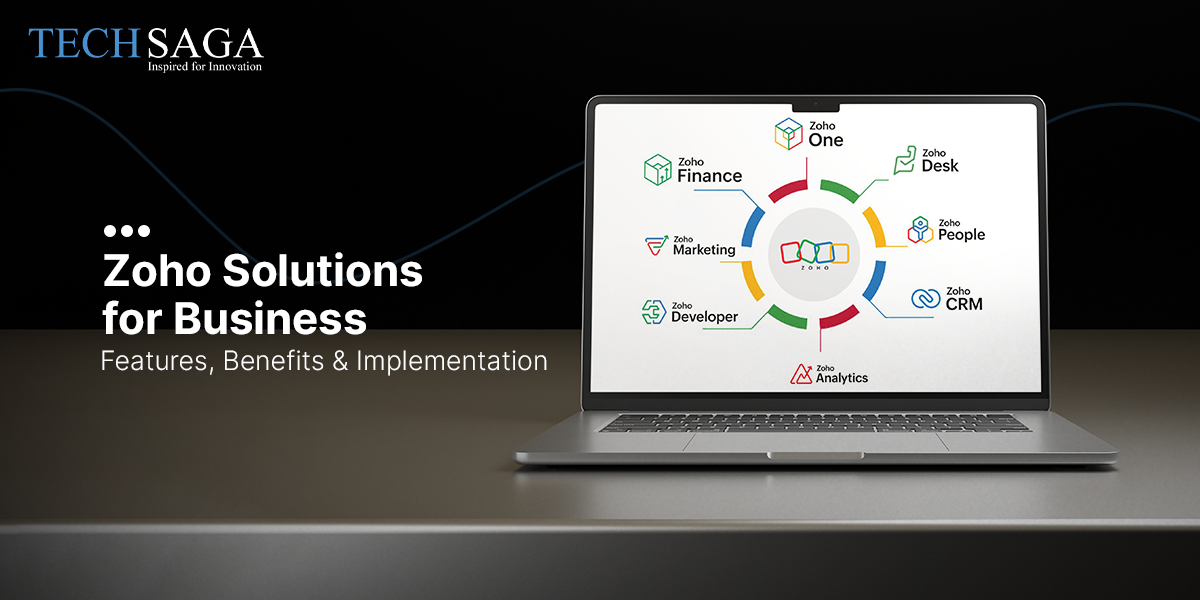
Zoho Solutions for Business: Features, Benefits & Implementation
The realization that our tools are working against us usually comes quietly. We sit there watching teams manually transfer contact data across three different open tabs, hoping nothing gets lost in the digital ether. Modern business was supposed to be simplified by technology but instead, we have ended up with fragmented systems that demand constant maintenance. Solving this operational friction requires a shift toward unified ecosystems, which is why forward-thinking organizations are adopting integrated Zoho CRM Solutions to build a single, resilient operational foundation.
The Operational Drain of Disconnected Software Platforms
When customer data sits in isolated pockets, teams spend more time copy-pasting than actually talking to clients. We see this constantly when analyzing how growing companies manage their communication lines. A lead comes through a website form. It sits in an inbox for two days. By the time sales finally sees it, the momentum is gone. The underlying problem is simple.Standard software stacks solved single problems. Software companies never designed them to run an entire business collectively.
Recent industry studies show that mid-market businesses waste roughly 20% of their operational capacity managing software friction and manual data syncing. That is a massive tax on growth. When a sales rep cannot see if a client has an outstanding invoice before pitching an upgrade, the business looks disjointed. These invisible gaps between tools create friction that customers feel immediately.
Why Rigid Configurations Quietly Break Frontline Sales Processes
Most sales tools fail because they demand too much admin work from people who should be out making deals. We have noticed that when systems are overly complex, teams simply stop updating them, leading to stale pipelines and useless forecasts. A system must mirror how your people actually talk to buyers, rather than forcing them into a rigid, academic structure.
Building flexible pipelines around real behavior changes how teams work. When customer communication history, support tickets and contract statuses live in one clear view, conversations become natural and informed. This level of clarity is why tailored software rollouts change client retention. We often look at how custom architectures smooth out these gaps, ensuring that tool configuration supports the human element of selling instead of fighting it.
Designing Intuitive Zoho Solutions for Frontline Teams
Systems should adapt to the messy reality of daily business operations. If a tool requires five clicks to log a basic phone call, people will skip it. Designing intuitive layouts means your frontline staff spends less time staring at forms and more time focusing on client problems.
Bridging Communication Gaps with Integrated Zoho Solutions
When support teams cannot see what sales promised or when sales is blind to a critical product issue a client is facing, trust erodes. Shared views across departments remove the guesswork. It allows the customer experience to feel consistent, regardless of who answers the phone.
Eliminating Manual Exports via Unified Zoho Solutions
Every manual data transfer is an opportunity for a critical typo. Automating the flow of details from an initial discovery call down to the final billing stage keeps the records clean. It ensures that everyone works from a single version of the truth.
The Logic Behind Structured System Deployment Strategies
Scrambling to launch an entire enterprise suite over a single weekend usually leads to absolute chaos. We have learned that the most sustainable way to update infrastructure is through a phased approach that handles critical dependencies first. You cannot build advanced marketing automation if your core customer database is still a mess of unverified spreadsheets.
Phase 1: Core Database Cleanse -> Phase 2: Pipeline Mapping -> Phase 3: Automation & Scale
A thoughtful Zoho Business Implementation begins by mapping out the exact data paths your team uses daily. Our work with enterprise clients shows that taking two weeks to shadow frontline workers reveals more about system requirements than any high-level executive meeting ever could. Fixing the small, frustrating bottlenecks first builds immediate trust with the staff who use the system daily.
Cleaning Legacy Data before Implementing Zoho Solutions
Importing 10 years’ worth of duplicate contacts and broken email addresses into a brand-new system destroys user adoption on day one. Spending time filtering and validating files ensures the new workspace feels organized and reliable from the very start.
Building Practical Training Loops Around Zoho Solutions
Long training videos rarely stick. We find that brief, interactive sessions focused on specific daily tasks work much better. When a user runs through a live scenario, they retain the process far more effectively than reading a standard manual.
The Financial Reality of Consolidating Corporate Software Licenses
Maintaining multiple enterprise software agreements gets incredibly expensive, especially when you calculate the hidden cost of custom API integrations. Many leadership teams are surprised to find they are paying for features that overlap across three different platforms. Consolidating into a single, cohesive ecosystem drastically lowers administrative overhead.
Our team at Techsaga recently evaluated an operations model where a client dropped four separate pipeline and billing subscriptions in favor of a unified system. The direct licensing savings were clear but the real win was eliminating the constant developer fees required to keep those old tools talking to each other. Adopting integrated Zoho Solutions provides companies with native connectivity, meaning your marketing, sales and accounting modules are inherently aware of each other without custom code.
Final Thoughts
There is a lot of noise about predictive intelligence but its actual value lies in taking repetitive, low-level tasks off your plate. Having a system that can flag an inactive account or auto-populate a renewal contract saves real time. The goal is to let software handle the predictable patterns so your people can manage the complex human relationships.
We often notice that when businesses adopt these smarter layers, their cultural energy shifts. Teams stop feeling like data entry clerks and start acting like strategists. Looking at the broader Zoho Business Benefits, the biggest return on investment is often the mental space it frees up across your departments, allowing individuals to focus on creative problem-solving and deep client care.
Every transition comes with its own set of minor operational headaches and adjustments. Yet, moving away from fragmented tools toward a unified architecture removes the heavy daily friction that quietly drains company momentum. When we at Techsaga help you streamline your backend, you give your teams the breathing room to deliver the kind of attentive, consistent service that builds lasting customer loyalty.
TAG: Techsaga USA