
Team Techsaga
Gain valuable insights and stay updated with the latest innovations through our engaging blog. Explore trends, technology advancements, and expert opinions to navigate the ever-evolving world of IT.
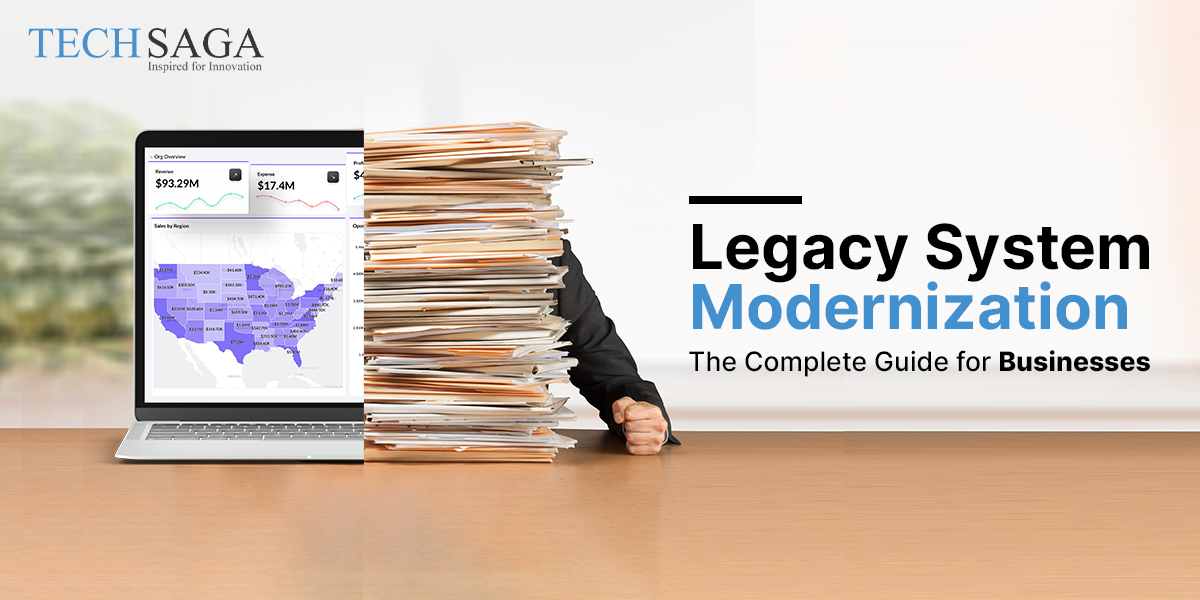
Legacy System Modernization:The Complete Guide for Businesses
Every company has that one system: a billing system from 2009 that everyone’s scared to touch. An ERP so heavily patched that nobody actually remembers what the original version looked like. A scheduling tool that only makes sense to the guy who built it, and he left the company three years ago. For a long time, these systems did their job well enough that nobody bothered replacing them. That’s kind of the problem. “It still works” used to be reassuring. Now it’s more of a red flag that keeps getting ignored a little too long.
Legacy System Modernization means upgrading or replacing outdated technology with secure, scalable systems built for today’s business needs. It improves performance, strengthens security, reduces IT costs, and helps businesses grow more efficiently.
It Still Works” Isn’t the Bar Anymore
There’s a big difference between a system that simply works and one that works efficiently. As vendor support ends and skilled developers become scarce, legacy systems grow costlier, less secure, and riskier to maintain.
Then there’s the integration headache. Modern applications rely on APIs and real-time data, but legacy systems often require manual workarounds, creating data silos, inefficiencies, and unreliable information across the business.
Performance takes a hit too, even if it’s less obvious on any single day. Slow interfaces. Dated screens. Systems that buckle the moment demand spikes. None of it looks urgent by itself, but it adds up quietly and eventually shows up as lost productivity, plus customers who feel the friction even if they can’t quite explain what’s wrong. By then, the cost of doing nothing has usually crept past the cost of just fixing it.
What Legacy System Modernization Actually Buys You
The payoff goes well past “newer software with a nicer dashboard.” When it’s done well, a modernization effort tends to move several things at once, not just one. Security gets stronger, since you’re working with modern frameworks and ongoing patching instead of hoping nothing slips through. Costs come down, because you’re no longer babysitting infrastructure that should’ve retired years ago. Performance and reliability improve across the board, not just in the parts users happen to notice. Integration gets easier too, plugging into cloud platforms and other tools without duct tape and manual exports holding it all together.
However, scalability stops being a worry, so growth doesn’t force a rebuild from scratch. Employees and customers both get a better experience day to day. And development speeds up, since teams aren’t fighting the old codebase just to ship a small change. Companies that get ahead of this tend to adapt faster when the ground shifts under them. The ones that wait usually end up modernizing under pressure after a breach, an outage, or a competitor pulling ahead instead of doing it on their own terms.
Four Ways to Approach Legacy System Modernization
There isn’t really a one-size-fits-all playbook that works for every business. The best direction comes down to budget, timeline, and then how critical the system is, like, in practice. Most organizations end up blending a couple of these things rather than commit to just one straight up. Sometimes it feels a bit unorganized, but it works anyway.
Rehosting, or “lift and shift,” means moving the application to the cloud largely as-is, with minimal code changes. It’s the fastest route, and usually the cheapest way to start trimming infrastructure costs. Not a permanent fix by any means, but a decent first step into cloud migration.
Replatforming goes a step further. You make targeted improvements so the application actually runs better once it’s in the cloud, without a full rebuild. It’s a reasonable middle ground if you want real gains without paying for a total overhaul.
Refactoring rewrites parts of an application to leverage cloud-native capabilities, improving flexibility, scalability, and long-term maintainability despite higher upfront effort.
And then there’s replacing the system entirely, usually with a mature SaaS platform. This comes up constantly with HR, payroll, and accounting systems, where building something custom rarely makes financial sense anymore. Most real modernization roadmaps end up blending all four, applied differently depending on which systems actually matter most.
Infrastructure Isn’t the Whole Story
Moving servers to the cloud only covers half the problem. App Modernization is about restructuring applications so they can actually perform and scale the way the business needs, not just moving them to a newer platform and calling it done. A lot of legacy applications were built as monoliths, where every feature is tightly coupled to every other feature. That’s fine right up until you need to change something, and then a small update turns into a multi-week project because touching one part risks quietly breaking three others you didn’t even think about.
Hence, moving toward APIs, containers, microservices, and more automated deployment pipelines kinda fixes most of that. When combined with a strong cloud migration strategy, application modernization creates a scalable, flexible IT environment that’s easier to manage, improves performance, and supports long-term business growth.
How to Move From a Legacy System Without Blowing Up the Business
Modernization doesn’t mean replacing everything at once. A phased, strategic approach is more practical, reduces risk, and makes it easier to gain leadership support and budget approval.
Start with a comprehensive assessment of your applications, databases, and dependencies. Identify where technical debt is highest, evaluate security risks, and determine which systems are critical to business operations. This helps prioritize modernization efforts where they’ll have the greatest impact.
Set clear, measurable objectives instead of vague goals. Focus on outcomes such as reducing infrastructure costs, improving application performance, strengthening security, or increasing scalability. Defined goals make it easier to measure success and justify investment.
Choose the right modernization strategy for each system. Some applications only require cloud migration, while others may benefit from refactoring, replatforming, or complete replacement. Avoid a one-size-fits-all approach, as different systems have different business and technical requirements.
Implement changes in phases rather than attempting a large-scale migration all at once. A gradual rollout allows teams to test, identify issues early, minimize disruption, and make adjustments before expanding deployment across the organization.
Finally, don’t overlook the people involved. Even the best technology can fail if employees aren’t properly trained or supported. Provide training, encourage feedback, and continuously monitor system performance and user adoption after implementation. Successful Legacy System Modernization is not just about upgrading technology—it’s about ensuring the business and its people are ready to make the most of it.
Where Techsaga Fits In
Modernizing legacy systems takes more than good intentions. It takes technical expertise and a clear understanding of business goals. Techsaga helps organizations assess legacy systems and build modernization strategies aligned with long-term growth.
Our services include legacy system assessment, application modernization, cloud migration, API integration, digital transformation, IT consulting, performance optimization, and end-to-end implementation support for successful modernization.
If you’re trying to figure out where your own systems actually stand, it is a decent place to start that conversation.
Conclusion
A legacy system that still runs isn’t the same as one that’s still serving the business well. The longer modernization gets pushed off, the more technical debt piles up, and the harder and pricier the eventual fix ends up being. Legacy System Modernization isn’t just an IT line item, even though it often starts out looking like one on a budget spreadsheet. It’s a strategic business decision that determines where an organization wants to be in the coming years and whether its technology is capable of supporting that vision.
As a key foundation of Digital Transformation, modernizing legacy systems helps businesses improve agility, strengthen security, and accelerate innovation. With the right strategy and an experienced partner like Techsaga, organizations can modernize on their own timeline instead of being forced into costly, reactive upgrades later.
TAG: Techsaga USA