
Team Techsaga
Gain valuable insights and stay updated with the latest innovations through our engaging blog. Explore trends, technology advancements, and expert opinions to navigate the ever-evolving world of IT.
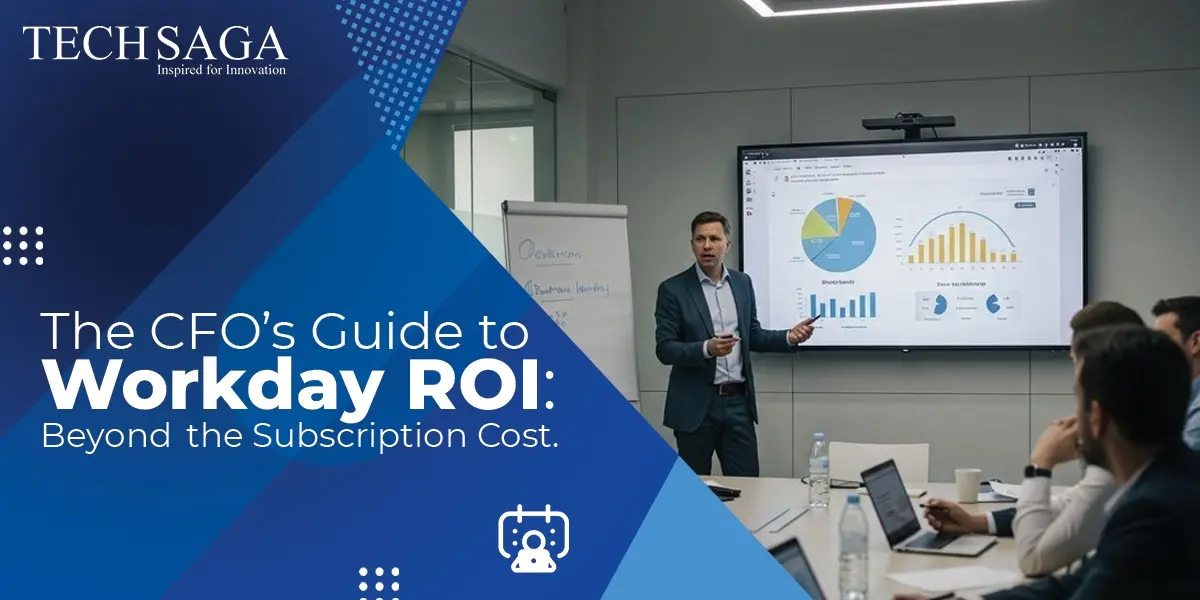
The CFO’s Guide to Workday ROI: Beyond the Subscription Cost
Workday ROI is more than just the license fee, as the real returns are achieved through increased efficiency, enhanced control, and consistent system use across teams. CFOs must look beyond the initial price to see how Workday enables the finance function daily. The real return on investment emerges when the teams can reduce errors, speed up reporting, and retain strong governance. These results frequently go up even further with the right operating model and a steady engagement through Workday Managed Services.
How CFOs Should View Workday ROI
CFOs associate ROI with savings, speed, accuracy, and risk control. Hence, ROI has to demonstrate a clear financial impact in the core of the daily operations. However, the subscription cost is only for accessing the platform. Therefore, the long-term value is heavily reliant on adoption, process design, and governance.
From a CFO’s point of view, ROI consists of:
Lower operating costs
Workday automates repetitive finance and HR tasks. As a result, teams are less engaged in manual entries and corrections. Hence, staffing pressure decreases while the quality of output increases. These savings gradually double through the reporting cycles.
Stronger financial control
Centralized data empowers forecasting and budget discipline. Hence, CFOs monitor spending patterns at the early stage and can adjust their plans quickly. This control alleviates surprises during audits and financial reviews.
Core Drivers of Workday ROI
Workday delivers ROI through efficiency, visibility, and cost stability. Hence, CFOs should consider how these drivers operate together.
Primary ROI drivers are:
Process efficiency
Workday harmonizes workflows across finance and HR. Consequently, approvals get quicker, and exceptions lessen. Hence, close cycles shorten, and teams reach deadlines with less work and more of a result, time. By consistent processes, reliability is improved in the long run.
Financial visibility
Interactive dashboards display the up-to-the-minute financial positions. Consequently, leaders examine performance without having to wait for reports. Enhanced visibility facilitates decisions at a faster rate and, subsequently, increases the level of trust in planning discussions.
IT and support savings
Cloud delivery eliminates the need for internal infrastructure. As a result, the costs for hardware are saved while maintenance is relieved. Thereby, the long-term IT spend is reduced, as it is free from large upgrade projects due to the automatic updates.
Governance and Performance Tracking
Effective governance is essential to keeping ROI measurable and controlled. Hence, one of the roles of CFOs is to regularly track outcomes. Ownership and review cycles that are clearly defined contribute to Workday being a tool that is in line with financial goals.
Governance practices revolve around:
Defined ownership
Clarity of responsibility leads to the assignment of system ownership to the teams. As a result, decisions are made quickly, and issues are resolved without waiting for a long time. This arrangement not only speeds up decision-making but also elevates the level of accountability between finance and HR. In the long run, ownership becomes a safeguard against process drift and variations in usage.
Regular performance reviews
Continuous reviews keep track of the levels of adoption, quality of data, and outcomes of the processes. Therefore, CFOs are able to discover the gaps well before they have an impact on results. Besides, these reviews serve as a platform for better planning and prioritizing. Thus, the teams are able to not only protect ROI but also maintain alignment with business needs.
Sustaining ROI Over Time
ROI does not remain stable without intervention. Hence, CFOs are required to make plans for continuous improvement. As the needs of the business evolve, systems must be given regular attention in order to continue delivering value.
The factors contributing to sustainability are:
Continuous optimization
Workday delivers regular updates that bring new features and improvements. Nevertheless, the overall value is limited when features are not being used. Regular reviews allow teams to figure out what is of most importance. Consequently, finance and HR teams align the system with current goals. This approach keeps processes relevant and efficient over time.
User adoption and training
The behavior of users has a direct impact on ROI. Thus, role-based training should be maintained. Clear instructions enable users to carry out tasks correctly and more quickly. Consequently, errors decrease and confidence increases. Over time, regular use becomes a system’s reliability, and output quality is strengthened.
ROI Beyond Cost Savings
Workday return on investment (ROI) can also be found in risk reduction and employee experience. Hence, CFOs should factor in these aspects when assessing the value of their investment. These advantages are a foundation for long-term stability and cost control.
Other areas of ROI include:
Risk and compliance control
Workday reinforces data governance through the restriction of access and auditing of all changes. Consequently, teams are better equipped to protect sensitive data. Compliance risks diminish, and audits become easier. This type of security saves valuable time and helps avoid financial penalties.
Employee experience impact
Self-service tools free the HR teams from routine queries and tasks. Hence, employees get their issues solved in a shorter time. Response times are enhanced, and frustration is lowered. Good experiences become a driver for retention, and the costs of recruitment and onboarding will gradually decrease.
Partner Choice and ROI
The rise of ROI outcomes depends on the quality of the implementation, which, in turn, necessitates the proper selection of a partner. The right partner can lead an organization through the common pitfalls.
A strong partner delivers:
Implementation and optimization expertise
Correct design of processes from the start is what the experienced teams do. Hence, the configurations correspond to the business needs. The timeline gets controlled as the rework reduces. In this way, early ROI gains are protected.
Ongoing advisory support
As the needs change, guidance helps the teams to adapt. Thus, the organizations become better responders to the updates and the growth. Long-term value and system performance are protected by many CFOs partnering with the top Workday consulting firms.
Conclusion
Sustainable ROI is achieved by CFOs who pay attention to factors such as adoption, efficiency, governance, and risk control rather than just subscription pricing. The real long-term value lies in the consistent usage, data discipline, and continuous improvement. When Workday enables faster decisions, cleaner reporting, and operational risk reduction, ROI becomes apparent across the organization. Also, many finance leaders take this a step further by collaborating with top Workday consulting firms that guide optimization and long-term success.
Why Techsaga Corporations
Techsaga Corporations is with the CFOs every step of the Workday journey. Our team facilitates better adoption, streamlines processes, and enhances the accuracy of reporting. Consequently, companies get more control, clearer insights, and a consistent return on investment that lasts beyond the subscription cost.
TAG: Techsaga USA